On Thursday last week, I presented at IMRG's excellent cross-border ecommerce event.
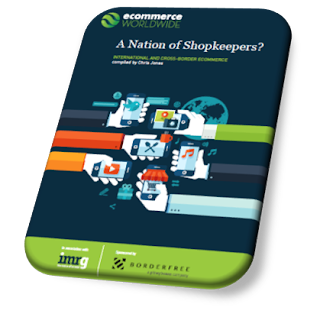
IMRG, sponsored by Borderfree, commissioned me to write a detailed "how to do it" guide to trading internationally via ecommerce especially for the event (and made a lovely job of the graphic design too!):
The output is this 48-page in-depth guide to using e-commerce to sell your products to international customers. It's available to download by clicking on the picture.
The emphasis of the paper is on being a detailed, practical, "how to do it" guide. As well as being packed with facts and data, it also includes a dozen detailed checklists for developing a project plan, as well as many essential frameworks to help decide how, when, where, and of course whether international e-commerce could be a successful route-to-market for your brand.
Showing posts with label International eCommerce. Show all posts
Friday, 25 September 2015
Saturday, 12 April 2014
C.O.D. - Care of the Devil?
Speaking about International eCommerce
International eCommerce seems to be a hot topic right now. Retailers, and most especially Brands, who have invested in their online capabilities for their domestic market, see an opportunity to leverage this investment by extending their offer to the whole world. I presented recently on this subject at at RBTE Expo 2014 at Earls Court (as well as being on the panels at eCommerce Futures in both London and New York) and I plan to use it as the basis of another short series of posts.It's always rather challenging trying to select material from such a broad subject in order to fit into a short presentation. At RBTE I was given a longer-than-usual 30 minute slot (typically the best/longest slots inevitably go to the sponsors of course!) which gave me a chance to cover a wider range of areas than usual. What's always particularly interesting about speaking at these events is to see which topics or slides get the strongest reaction from the audience.
And then last week I had the opportunity to work onsite with a client in Kiev Ukraine, a consumer electronics retailer interested in learning the lessons from Amazon vs BestBuy / Amazon vs Currys history to make sure that they don't go the way of Comet. Online retail in the Ukraine is probably around 8-10 years behind the UK or US, which creates lots of opportunities for them to study the mistakes western retailers made in failing to adapt fast enough and avoid repeating them. (And yes, although Amazon are not in Ukraine, local online pure-plays are trying to learn lessons from Amazon themselves and make sure the local brick-and-mortar players make the same mistakes as Comet did...)
Cash on Delivery
What's been particularly fascinating about having these experiences close together was that the same slide got the strongest reaction at both events - this one, about the percentage of eCommerce transactions that are completed in cash.
My Ukrainian clients found it difficult to believe that so many UK consumers would be prepared to pay for goods in such large numbers before physically seeing them, even from reputable retailers. By contrast: yes, UK and US readers, that means actual folding money handed over on the doorstep.
For western retailers thinking about trying to sell into say Russia, Romania or Ukraine, this presents some interesting issues. On the one hand there actually some advantages to transacting in cash. For one thing, the checkout - normally the most complex part of a website - is rather simple. You just get some basic contact details from the customer, telephone them to sort out delivery (oh yes, this is also standard practice by the way, so start employing some more local language speakers than you planned just for after-sales calls) and that's it. No messing around with multi-step checkouts and all those complicated "what happens if they press the back-button" type questions.
On the other hand - quite apart from the challenge of handling cash anyway - your entire after-sale standard operating procedures, and probably your finance policies, are going to need a rewrite. The problem, simply stated, is that the sale takes place spread over time. If you take credit card payments, then the payment, stock movement, general ledger posting and GAAP compliant booking of the sale are more or less simultaneous. And if there's a problem with the order during shipping, your call-centre knows it needs to cancel/refund the payment:
By comparison, paying on delivery smears this transaction across time. And now if there's a problem during shipping, then no refund is needed. But of course, if your customer decides not to be at home, or doesn't like the goods on the doorstep, then you just took all that shipping cost and received no money for it.
German retailers, of course, have dealt with this complexity from the get-go. Here's a screenshot taken from www.idealo.de, a German price comparison site:
"Nachnahme" - cash on delivery - with its inherently higher risk of non-completion of the order, is going to cost you a a good bit more than paying upfront. Notice that they really don't want you to pay by expensive (for the retailer) methods like credit card either. Cash up-front or bank-transfer up-front please!
Coda
I'm writing this on 12th April 2014, and of course the situation might change. But I'd like to just take the opportunity to quote from an email invitation (I'm sure the author won't mind) I've just received to do another piece of consulting for a different client in Kiev:
"P.S.
Perhaps a helpful note, given the increased media attention to Ukraine these
days: Kiev, the capital, is peaceful and safe, despite popular protests in the
east of the country."
Since I was there myself at the time I received this particular email, I could see for myself whether this was true. And it was. A little bizarrely the centre of the protests in Independence Square has become a tourist attraction with former protesters selling souvenirs such as spent bullets:
And Kiev really is a beautiful city, especially as the exchange rate has just improved by 50% due to all the uncertainty:
Monday, 15 October 2012
Delivery pricing
Firstly a big thank you to those who sent me feedback on my last post about click-and-collect (and especially to those who "liked" it or forwarded it to all their contacts in turn)!
And now, a warning...
You cannot proceed because you have not reached the minimum order value of €19. Eh?? And this is only the German site. If you want to try the same thing in Belgium, then it's €25.
Congratulations to C&A on possibly the most unorthodox way of avoiding "sticker-shock" at checkout I have yet seen! Doubtless they can be extremely confident that their online customers are not going to abandon their carts due to being unhappy with surprise delivery charges. And on the other hand, delivery is free if you spend more than this minimum. But this does seem a very strange way of emphasising their very strong "free delivery" message - by hiding it competely on the site homepage, and then jumping on you later if you try and checkout.
Better (best?) practice is demonstrated here by John Lewis. This is the top-left on their homepage (the red circle is my addition):
The free delivery message is considered so important it takes pride-of-place just below the navigation and above the hero product offer.
The C&A "alternative shock" approach seemed unusual enough to prompt a bit more research, and at least validate that my shock was not reflective of some British bias. I've taken a quick look at a few top British, French and German sites:
And no, nobody else is trying this "minimum cart size achtung" approach! No surprise there then... However the first surprise is how hard it is to find this information. Consumer unhappiness with delivery pricing is THE top reason for cart abandonment (assuming you have a basically clean-functioning site). From Forrester's 2010 cart abandonment reasons study:
So why hide it? Customers demand this information. No points to Next.co.uk, whose help pages were simply not working (it's a priority guys, not an annoying bit of the website that doesn't matter much). But particularly on the German sites, it is remarkably difficult to find the facts. A standard footer would be a strong recommendation (example from John Lewis again);
Second surprise is how few sites (and not just top sites) offer free delivery above a threshold level. Free delivery over threshold is a very good idea for a few reasons:
Very small online orders do need a delivery charge to be applied, because they are disproportionaly expensive to handle. The cost per unit sale for larger online orders is most likely comparable or lower than the cost of the equivalent store sale. Attempting to pass this cost onto customers, when they would not have paid the cost in store (has anyone tried charging a customer £3.95 to take their purchase through the store exit door?) is an artificial charge that is costing you sales.
This conclusion is starting to become particularly clear when you look at the cost of delivery for large articles such as white goods. To ship a washing-machine to a customer costs around £30-£35 in the UK. John Lewis charges nothing for white goods articles over £50, Tesco Direct charges a flat £7. Customers won't tolerate having the high cost of shipping passed through to them: it's not added in store, why should they pay it online? Sites such as Carrefour electricals (France: €59.99 (!!)), Baur (Germany: €39.95), MediaMarkt (Germany: €34,95) need to rethink their model sooner rather than later.
And now, a warning...
You cannot proceed because you have not reached the minimum order value of €19. Eh?? And this is only the German site. If you want to try the same thing in Belgium, then it's €25.
Congratulations to C&A on possibly the most unorthodox way of avoiding "sticker-shock" at checkout I have yet seen! Doubtless they can be extremely confident that their online customers are not going to abandon their carts due to being unhappy with surprise delivery charges. And on the other hand, delivery is free if you spend more than this minimum. But this does seem a very strange way of emphasising their very strong "free delivery" message - by hiding it competely on the site homepage, and then jumping on you later if you try and checkout.
Better (best?) practice is demonstrated here by John Lewis. This is the top-left on their homepage (the red circle is my addition):
The free delivery message is considered so important it takes pride-of-place just below the navigation and above the hero product offer.
The C&A "alternative shock" approach seemed unusual enough to prompt a bit more research, and at least validate that my shock was not reflective of some British bias. I've taken a quick look at a few top British, French and German sites:
And no, nobody else is trying this "minimum cart size achtung" approach! No surprise there then... However the first surprise is how hard it is to find this information. Consumer unhappiness with delivery pricing is THE top reason for cart abandonment (assuming you have a basically clean-functioning site). From Forrester's 2010 cart abandonment reasons study:
And the top consumer expectation of a website is that pricing and shipping information is clear:
So why hide it? Customers demand this information. No points to Next.co.uk, whose help pages were simply not working (it's a priority guys, not an annoying bit of the website that doesn't matter much). But particularly on the German sites, it is remarkably difficult to find the facts. A standard footer would be a strong recommendation (example from John Lewis again);
Second surprise is how few sites (and not just top sites) offer free delivery above a threshold level. Free delivery over threshold is a very good idea for a few reasons:
- checkout conversion rates are known to be lower at psychologically critical price points (it's the old $9.99 thing again), especially at the critical 3-digit point in dollars, euros or pounds. If you want those €95 carts to convert - a figure remarkably close to the average cart size on many sites - don't slap a delivery charge on which takes it over the €100 mark.
- customers will add an extra article to their cart to get above the free delivery threshold. Set your free threshold to just above your typical cart size!
- any free delivery message is a very powerful messaage
- turning away orders (like C&A) is turning away all distress-purchases. Given that a primary driver for customers to use online is convenience, eliminating all those potential customers having a panic-buy moment for that item they desperately need for their summer holidays is a big loss of trade. OK, servicing small orders is expensive, but customers will pay for this convenience. Make the charge standard, waive it over any reasonably threshold.
Very small online orders do need a delivery charge to be applied, because they are disproportionaly expensive to handle. The cost per unit sale for larger online orders is most likely comparable or lower than the cost of the equivalent store sale. Attempting to pass this cost onto customers, when they would not have paid the cost in store (has anyone tried charging a customer £3.95 to take their purchase through the store exit door?) is an artificial charge that is costing you sales.
This conclusion is starting to become particularly clear when you look at the cost of delivery for large articles such as white goods. To ship a washing-machine to a customer costs around £30-£35 in the UK. John Lewis charges nothing for white goods articles over £50, Tesco Direct charges a flat £7. Customers won't tolerate having the high cost of shipping passed through to them: it's not added in store, why should they pay it online? Sites such as Carrefour electricals (France: €59.99 (!!)), Baur (Germany: €39.95), MediaMarkt (Germany: €34,95) need to rethink their model sooner rather than later.
Sunday, 8 July 2012
Eastern Europe anyone? Ofcom statistics about Poland
With its economy closely coupled with that of Germany, Poland appears to have escaped the worst of the credit crunch. Economic growth in 2011 was over 4%. It should be fertile ground for retailers looking for new markets, especially with its strong links to the UK.
One of the most interesting charts produced by Ofcom recently (2010 data) is an analysis of the enthusiasm of online consumers - how often do you buy online? Poland is a very interesting edge case:
And online customers are growing fast, as this data from the 2011 Ofcom report shows:
Already ahead of Italy and Spain (where customers seems to like to browse online but not purchase), catching up rapidly on Ireland, and showing similar growth to France.
So if you are looking to reach out to another customer market, have a serious think about translating your site into Polish... There are some other advantages to Poland too. Delivery infrastructure is well developed, with major players like DHL well established, and payment methods are less "eccentric" than some other apparently easier potential markets (e.g. Netherlands, France, Germany, Belgium or Denmark all with challenging local schemes).
There's just one snag... in some categories everyone else is there too, especially the leading retailers from Germany and France. If you fancy somewhere a bit easier but with similar characteristics, try Czech. There are only 10.2M Czechs compared to 38.5M Poles, but there's a lot less competition as a consequence. Tesco are, however, using it as their pilot country for eCommerce in E.Europe, so move fast before it's taken!
One of the most interesting charts produced by Ofcom recently (2010 data) is an analysis of the enthusiasm of online consumers - how often do you buy online? Poland is a very interesting edge case:
OK, spend per head is not so high, reflecting its relatively low GDP per head, the value of the Zloty, and its economic development stage. But just look at that spend frequency: second in Europe only behind the UK! (and the UK is a weird edge case anyway, nowhere else are consumers as enthusiastic about online retail). There is anecdotal evidence that other very developed E.European markets, especially Czech, show similar behaviour, but unfortunately no data.
And online customers are growing fast, as this data from the 2011 Ofcom report shows:
Already ahead of Italy and Spain (where customers seems to like to browse online but not purchase), catching up rapidly on Ireland, and showing similar growth to France.
So if you are looking to reach out to another customer market, have a serious think about translating your site into Polish... There are some other advantages to Poland too. Delivery infrastructure is well developed, with major players like DHL well established, and payment methods are less "eccentric" than some other apparently easier potential markets (e.g. Netherlands, France, Germany, Belgium or Denmark all with challenging local schemes).
There's just one snag... in some categories everyone else is there too, especially the leading retailers from Germany and France. If you fancy somewhere a bit easier but with similar characteristics, try Czech. There are only 10.2M Czechs compared to 38.5M Poles, but there's a lot less competition as a consequence. Tesco are, however, using it as their pilot country for eCommerce in E.Europe, so move fast before it's taken!
Thursday, 21 June 2012
No Man is a River Island
Or "how to forget the basic hygiene factors when trying to do international ecommerce".
Today River Island has a special international free delivery offer on its site. Special enough to be the banner on its homepage, and in fact to potentially cost River Island £7 or more per order.
Great!
So what happens if I try to take advantage of this offer?
Well, first of all I have to register. Why? Why is there no anonymous checkout option? If English is not your first language, have you ever tried to follow in the instructions on one of these forms that insists on a strong password with a weird '*&!()***' character and a number in it? If English is your first language, try registering on a French or German site now, and see how you get on...
In countries which are more nervous about data protection than British consumers, Germany for example, or Holland which is one of River Island's core target markets, this has already cost them at least 25% of their potential new sales, possibly more.
To be fair, they then jump the next hurdle successfully: the site at least manages not to demand a UK postcode/housenumber combo for customers who indicate they are not based in the UK.
But then, they lose the next 25% of the potential overseas customers with one simple, glaring error: you can't enter an international phone number! Their phone number field only accepts the digits 0-9. So if you try to use the standard international convention of +countrycode, your number gets rejected, and you can't proceed any further. Game over.
"! we think you've mis-typed your phone number - please try again"
No I haven't, I'm just trying to take advantage of your free delivery offer, but my phone number looks like this: +44 (0) 1234 567890.
Then I'd like to pay. River Island has stores in the Netherlands and Belgium, they are key target markets for its international offer. Google for "River Island .nl" and you get directed to the UK site. Fair enough. But...
Dutch customers like to pay using a scheme called Ideal. In fact >50% of all eCommerce transactions in Holland are conducted using Ideal. Does the River Island site support Ideal? Of course not.
Now of course it's quite challenging to incorporate all the possible local schemes into a website checkout, even if you have a worldwide payment gateway. In most of western Europe, however, there is a quite reasonable alternative: PayPal. However their site doesn't support it, and in fact goes so far as to provide a separate help page explaining that no, they don't support PayPal.
Yes, of course they support MasterCard and Visa. But European customers are much less likely to be prepared to use such a card online than the British are, even if they have one (in a country like Belgium, another core River Island market, they possibly don't).
I wonder if River Island's payment gateway has a default fraud-prevention rule in it blocking non-British card BIN ranges! Lots of retailers do this automatically. Given how little else seems to have been tested, I wonder if they've tested this.
It takes more than adding an international delivery address-box and an international parcel-courier to be ready for international eCommerce, and River Island unfortunately falls at the second and third hurdles. Nul points.
Today River Island has a special international free delivery offer on its site. Special enough to be the banner on its homepage, and in fact to potentially cost River Island £7 or more per order.
Great!
So what happens if I try to take advantage of this offer?
Well, first of all I have to register. Why? Why is there no anonymous checkout option? If English is not your first language, have you ever tried to follow in the instructions on one of these forms that insists on a strong password with a weird '*&!()***' character and a number in it? If English is your first language, try registering on a French or German site now, and see how you get on...
In countries which are more nervous about data protection than British consumers, Germany for example, or Holland which is one of River Island's core target markets, this has already cost them at least 25% of their potential new sales, possibly more.
To be fair, they then jump the next hurdle successfully: the site at least manages not to demand a UK postcode/housenumber combo for customers who indicate they are not based in the UK.
But then, they lose the next 25% of the potential overseas customers with one simple, glaring error: you can't enter an international phone number! Their phone number field only accepts the digits 0-9. So if you try to use the standard international convention of +countrycode, your number gets rejected, and you can't proceed any further. Game over.
"! we think you've mis-typed your phone number - please try again"
No I haven't, I'm just trying to take advantage of your free delivery offer, but my phone number looks like this: +44 (0) 1234 567890.
Then I'd like to pay. River Island has stores in the Netherlands and Belgium, they are key target markets for its international offer. Google for "River Island .nl" and you get directed to the UK site. Fair enough. But...
Dutch customers like to pay using a scheme called Ideal. In fact >50% of all eCommerce transactions in Holland are conducted using Ideal. Does the River Island site support Ideal? Of course not.
Now of course it's quite challenging to incorporate all the possible local schemes into a website checkout, even if you have a worldwide payment gateway. In most of western Europe, however, there is a quite reasonable alternative: PayPal. However their site doesn't support it, and in fact goes so far as to provide a separate help page explaining that no, they don't support PayPal.
Yes, of course they support MasterCard and Visa. But European customers are much less likely to be prepared to use such a card online than the British are, even if they have one (in a country like Belgium, another core River Island market, they possibly don't).
I wonder if River Island's payment gateway has a default fraud-prevention rule in it blocking non-British card BIN ranges! Lots of retailers do this automatically. Given how little else seems to have been tested, I wonder if they've tested this.
It takes more than adding an international delivery address-box and an international parcel-courier to be ready for international eCommerce, and River Island unfortunately falls at the second and third hurdles. Nul points.
Subscribe to:
Posts (Atom)


